How Much Can Better Car Photos Increase Sales? The Direct Answer
How much can better car photos increase sales? Research and industry data consistently show that high-quality vehicle photography can increase click-through rates by 40% or more, reduce days-to-sale significantly, and drive measurably higher listing engagement. For dealerships managing dozens or hundreds of vehicles, the cumulative revenue impact is substantial—often translating to tens of thousands of dollars in additional gross profit per year.
Why Vehicle Photography Is a Front-Line Sales Tool in 2026
The modern car-buying journey begins online. According to Cox Automotive’s annual car buyer research, more than 80% of car buyers conduct their vehicle search online before ever visiting a dealership. That means your listing photos are your first—and sometimes only—opportunity to earn a buyer’s attention.
In a marketplace crowded with inventory, a blurry parking lot snapshot does not just underperform; it actively repels buyers. Showroom-ready images, by contrast, communicate professionalism, build trust, and signal that a dealership takes pride in its inventory. The difference between an average photo and a dealer-quality photo is not cosmetic—it is commercial.
The Data: How Much Better Car Photos Increase Sales
Let us look at what the numbers actually say about how much better car photos can increase sales across key performance metrics.
1. Click-Through Rate (CTR)
Listings with professional, high-resolution imagery consistently outperform those with poor-quality photos on major platforms such as AutoTrader, Cars.com, and mobile.de. Industry data from marketplace platforms indicates that optimized vehicle listings with clean, consistent imagery generate between 30% and 45% more clicks than equivalent listings with low-quality photos.
Higher CTR means more buyer inquiries, more test drive requests, and ultimately more sales opportunities—all without increasing your advertising spend.
2. Days on Lot (Time-to-Sale)
Days on lot is one of the most critical metrics in dealership profitability. Every additional day a vehicle sits unsold increases holding costs. According to vAuto market data cited by industry analysts, vehicles with complete, high-quality photo sets sell faster than those with incomplete or poor-quality imagery—with some segments showing a reduction of 10 to 15 days on lot for well-photographed listings.
For a used car operation managing 100+ vehicles, compressing average days on lot by even one week across inventory can represent a significant reduction in floorplan interest and carrying costs.
3. Listing Engagement and Lead Quality
Buyers who engage with high-quality imagery spend more time on a listing, view more photos, and are more likely to submit a lead form. Research from digital automotive retail platforms suggests that listings with six or more high-quality images receive substantially more serious inquiries than those with fewer or lower-quality photos.
Lead quality improves too—buyers arrive better informed, with more realistic expectations, reducing the risk of disappointment upon inspection.
4. Perceived Vehicle Value and Pricing Power
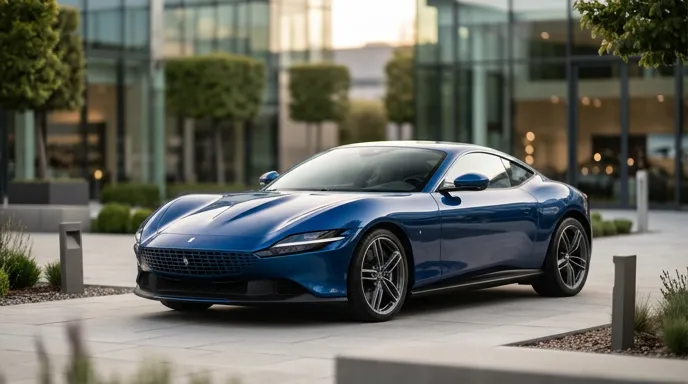
Dealer-quality photos do more than attract clicks—they influence how buyers perceive a vehicle’s value. A well-presented vehicle in a clean, neutral setting photographs as worth more than the identical vehicle shot against a cluttered lot background. This perception gap can support stronger asking prices and reduce the depth of price negotiations.
The Parking Lot Problem: Why Most Dealer Photos Underperform
Most dealership photos are taken in the lot under inconsistent lighting, with distracting backgrounds—overhead signs, other vehicles, service bay clutter—and without any post-processing. These photos accurately represent where the car was photographed, not the car itself.
AI background replacement technology directly solves this problem. Tools like Car Studio replace parking lot backgrounds with clean, professional studio-style environments in minutes—without moving the vehicle, renting a studio, or hiring a photographer. The result is a showroom-ready image from a standard parking lot shot.
This is precisely where understanding how much better car photos can increase sales becomes actionable: the improvement is not hypothetical. It is a direct function of removing the visual friction that prevents buyers from engaging with your listings.
5 Ways AI Photo Editing Directly Impacts Sales Performance
- AI background replacement removes distracting lot environments and presents each vehicle in a clean, consistent setting that builds buyer confidence and increases listing click-through rates.
- License plate blur and removal ensures listings comply with privacy regulations and platform policies—protecting both the dealership and the seller—while keeping images professional.
- Marketplace-optimized exports ensure images meet the exact specifications required by AutoTrader, Cars.com, Facebook Marketplace, mobile.de, OLX, and other platforms, preventing rejection and maximizing display quality.
- Batch processing enables dealers to edit an entire inventory set in a fraction of the time required by manual methods—reducing time-to-listing and ensuring no vehicle sits unpublished longer than necessary.
- Consistency across inventory creates a cohesive brand presentation that signals professionalism and builds buyer trust across every listing on your lot.
Real-World Workflow: From Parking Lot to Showroom in Minutes
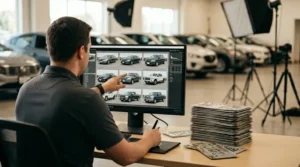
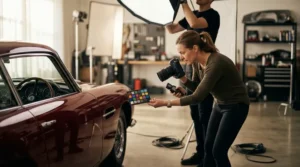
Consider a mid-size independent dealership managing 80 to 150 vehicles. Traditionally, producing dealer-quality photos for that inventory required scheduling a photographer, waiting for ideal lighting conditions, and hours of manual editing. That process added cost and delay to every new listing.
With an AI-powered automotive dealership photo editing platform like Car Studio, the workflow changes entirely. A lot photographer captures standard shots with a smartphone or DSLR. Those images are uploaded to the platform, backgrounds are replaced automatically, license plates are blurred for privacy compliance, and marketplace-optimized image exports are generated—all within minutes per vehicle.
The time saved is reallocated to listing more vehicles faster, reducing days on lot, and improving overall inventory turn. The cost savings versus outsourced photography or manual retouching are immediate and compounding.
Inventory Photography Best Practices for 2026
Technology amplifies the quality of input. To maximize the ROI from vehicle listing optimization, we recommend the following capture standards:
- Shoot in consistent natural light—overcast days produce even, shadow-free images that process better through AI tools.
- Follow a standardized angle sequence: front three-quarter, rear three-quarter, driver side, passenger side, front, rear, and key interior shots.
- Keep the vehicle clean before photographing—AI background replacement presents the vehicle accurately and cannot compensate for visible dirt or debris.
- Use the highest resolution setting available on your device to ensure marketplace-optimized exports meet platform quality thresholds.
- Maintain a consistent shooting distance and height across all vehicles to create a uniform inventory presentation.
Frequently Asked Questions
How much can better car photos increase sales for a small dealership?
Even for small dealerships with 20 to 50 vehicles, improved photography can increase click-through rates by 30% or more and reduce days on lot by one to two weeks. The ROI is proportional to inventory size but meaningful at every scale.
Does AI background replacement look realistic to buyers?
Yes. Modern AI background replacement tools produce clean, professional results that buyers consistently find credible and appealing. The vehicle itself remains accurately represented—only the distracting lot environment is replaced with a neutral, studio-style background.
How to Shoot Car Photos That Actually Sell
For a visual demonstration of these photography principles in action, The Logbook walks through the specific techniques that make car listings stand out to potential buyers. You’ll see how lighting, angles, and composition directly impact how buyers perceive a vehicle’s value and condition.
What platforms accept AI-edited car photos?
AutoTrader, Cars.com, Facebook Marketplace, mobile.de, OLX, and most major automotive marketplaces accept AI-edited vehicle images, provided the vehicle is accurately represented and images meet platform specifications. Marketplace-optimized exports from platforms like Car Studio are pre-formatted to meet these requirements.
How does license plate blur help dealerships?
License plate blur protects seller and buyer privacy, supports compliance with GDPR and regional data protection regulations, and meets the image policies of major listing platforms. It is a best practice for any dealership publishing vehicle photos online.
How quickly can a dealership see results from better vehicle photos?
Results are typically visible within the first listing cycle. Improved CTR and increased inquiry volume are measurable within one to two weeks of publishing updated photography, particularly on high-traffic platforms.
Is batch processing effective for large inventories?
Batch processing is essential for dealerships managing 50 or more vehicles. It ensures consistent quality across all listings, dramatically reduces per-vehicle editing time, and enables rapid time-to-listing for new arrivals.
Key Takeaways
- Better car photos can increase listing click-through rates by 30% to 45%, directly generating more buyer inquiries without additional ad spend.
- Improved vehicle photography can reduce days on lot by 10 or more days, lowering holding costs and improving inventory turn.
- AI background replacement converts standard parking lot photos into showroom-ready images in minutes, making dealer-quality photography accessible at scale.
- License plate blur and privacy-compliant image handling protect dealerships and support compliance with marketplace policies and data regulations.
- Marketplace-optimized exports ensure images meet platform specifications on AutoTrader, Cars.com, mobile.de, and other key channels.
- Batch processing enables consistent, professional inventory photography workflows regardless of lot size—from 20 to 500+ vehicles.
Conclusion: The ROI of Better Vehicle Photography Is Measurable
Understanding how much better car photos can increase sales is not a theoretical exercise—it is a measurable, actionable insight that dealerships can apply immediately. Higher click-through rates, faster time-to-sale, improved lead quality, and stronger pricing power all flow directly from presenting inventory in its best accurate light.
The barrier to professional vehicle imagery has been removed by AI-powered tools that work at the speed and scale modern dealerships require. There is no longer a reason to publish parking lot snapshots when showroom-ready images are achievable in minutes.
We invite you to explore what Car Studio can do for your inventory photography workflow. Visit CAR STUDIO — AI Car Photo Editing for Dealers and see how AI background replacement, license plate blur, and marketplace-optimized exports can transform your listings—and your sales performance.
Infographic