AI vs Manual Car Photo Retouching: A Complete 2026 Comparison
When it comes to the AI vs manual car photo retouching comparison, the answer is clear for most dealerships in 2026: AI-powered editing delivers showroom-ready results in minutes, at a fraction of the cost of manual workflows. For dealers managing dozens or hundreds of vehicle listings, the choice directly impacts time-to-listing, photo quality consistency, and ultimately, click-through rates on major marketplaces.
In this guide, we break down both approaches across speed, cost, quality, and scalability—so you can make an informed decision for your inventory photography workflow.
What Is Manual Car Photo Retouching?
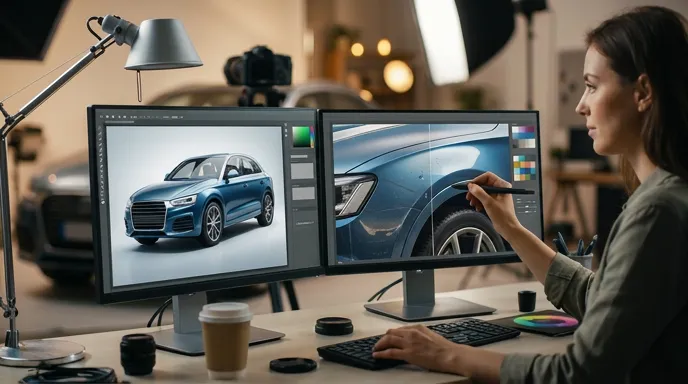
Manual car photo retouching is the process by which a human editor—typically a professional retoucher or graphic designer—individually edits each vehicle image using desktop software. This includes adjusting backgrounds, correcting exposure, removing unwanted elements, and preparing images for marketplace export.
Manual editing can produce highly customized results, but it comes with significant trade-offs in time and cost, especially for dealers handling high-volume inventory photography.
Typical Manual Retouching Workflow
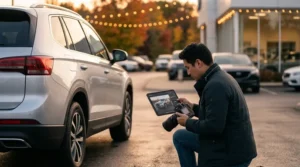
- Photographer captures parking lot photos on-site
- Images are transferred to an editor (in-house or outsourced)
- The editor processes each image individually—background removal, color correction, cropping
- Edited images are reviewed, revised if needed, and exported
- Final files are uploaded to marketplace listings
Industry data suggests this full cycle can take anywhere from 2 to 5 business days per batch of 20–30 vehicle photos, creating a significant bottleneck between acquisition and listing.
What Is AI Car Photo Retouching?
AI car photo retouching uses machine learning models trained specifically on automotive imagery to automate background replacement, license plate blur and removal, lighting normalization, and marketplace-optimized exports—without manual input for each image.
Platforms like Car Studio are purpose-built for automotive dealerships, enabling batch processing of entire inventory lots in minutes rather than days.
Typical AI Retouching Workflow
- Dealer or lot photographer uploads parking lot photos directly to the platform
- The AI automatically detects the vehicle, removes or replaces the background
- License plate blur or removal is applied automatically for privacy compliance
- Images are exported in formats optimized for AutoTrader, Cars.com, Facebook Marketplace, mobile.de, OLX, and other platforms
- Dealer-quality photos are ready to publish within minutes
The entire process—from upload to marketplace-ready export—can be completed in under 10 minutes for a full set of vehicle images.
AI vs Manual Car Photo Retouching Comparison: 5 Key Dimensions
1. Speed and Time-to-Listing
Manual editing typically requires 15–30 minutes per vehicle image set when handled by a skilled retoucher. For a dealership with 50 active listings, that translates to 12–25 hours of editing time per inventory refresh.
AI retouching processes the same 50-vehicle inventory in under 30 minutes using batch processing. Research in the automotive retail sector consistently shows that faster time-to-listing correlates directly with higher inquiry rates, as vehicles listed within 24 hours of acquisition attract significantly more early-buyer attention.
Winner: AI retouching—no comparison in speed for high-volume dealerships.
2. Cost Per Vehicle
Manual editing costs vary widely. Outsourced retouchers typically charge between $3 and $15 per image, while in-house editors represent fixed salary costs regardless of inventory volume. For a dealer listing 100 vehicles per month at $5 per image set, that amounts to $500–$1,500 monthly in editing costs alone.
AI retouching platforms operate on subscription or per-image models that reduce the per-vehicle cost substantially, especially at scale. Batch processing further reduces the effective cost per image as volume increases.
Winner: AI retouching—significantly lower cost at any meaningful inventory volume.
3. Consistency and Quality
One of the most overlooked factors in the AI vs manual car photo retouching comparison is consistency. Manual editing quality varies based on individual retoucher skill, workload, and fatigue. Background styles, color grading, and composition can differ noticeably across a single inventory batch.
AI retouching applies the same processing parameters to every image, ensuring a uniform, professional appearance across all listings. This consistency is critical for brand perception on major marketplaces, where visual cohesion builds buyer trust.
That said, highly complex or unusual images—vehicles with unique angles, heavy environmental obstructions, or non-standard configurations—may occasionally require a manual review step even within an AI workflow.
Winner: AI retouching for consistency; manual for highly complex edge cases.
4. Privacy and Compliance (License Plate Handling)
Privacy regulations, including GDPR in Europe and various regional data protection requirements, increasingly require that license plates in publicly listed vehicle images be obscured. Manual editors can handle this, but it adds time and introduces human error.
AI platforms with integrated license plate blur and removal capabilities handle this automatically at the point of processing—ensuring every exported image is compliant before it reaches the marketplace. This removes a compliance burden that dealers managing large inventories often underestimate.
Winner: AI retouching—automated compliance reduces risk and saves time.
5. Scalability for Dealership Growth
As a dealership grows—whether from 50 to 200 vehicles per month or expanding to multiple locations—manual editing workflows scale linearly with cost and headcount. Hiring more retouchers, managing quality control, and maintaining turnaround times becomes increasingly complex.
AI retouching scales effortlessly. A dealer processing 50 vehicles per month uses the same platform workflow as one processing 500. The automotive dealership photo editing platform grows with the business without proportional cost increases.
Winner: AI retouching—by design, it scales without added overhead.
When Manual Retouching Still Has a Role
We believe in presenting an honest assessment. Manual retouching retains value in specific, limited scenarios:
- Luxury or prestige vehicle marketing where bespoke, highly curated imagery justifies the added cost and time
- Complex composite photography for brand campaigns, not standard inventory listings
- Edge-case image correction when AI outputs require a human quality-control pass before publishing
For the vast majority of dealer inventory photography—particularly independent used car dealers, auction platforms, and fleet managers—manual retouching simply cannot compete with AI on any practical dimension.
How Car Studio Resolves the AI vs Manual Debate for Dealers
The AI vs manual car photo retouching comparison ultimately comes down to this: dealers need dealer-quality photos, marketplace-optimized exports, and a workflow that does not slow down their listings. Manual editing cannot reliably deliver all three simultaneously at volume.
AI vs. Manual Editing in Action
To see how these two approaches actually compare in real-world scenarios, Cassidy Lynne demonstrates both AI photo editing and manual retouching techniques side by side. This practical comparison shows the strengths and limitations of each method, helping you understand which approach might work best for different types of car photography projects.
Car Studio is purpose-built to turn parking lot photos into showroom-ready images in minutes. Key capabilities include:
- AI car photo background replacement: Automatically replaces any parking lot or cluttered background with clean, professional environments suited for marketplace listings
- License plate blur and removal software: Every image is automatically processed for privacy compliance before export
- Car marketplace optimized image exports: Images are formatted and sized to meet the technical requirements of AutoTrader, Cars.com, Facebook Marketplace, mobile.de, OLX, and other major platforms
- Batch processing: Process an entire vehicle inventory lot simultaneously, not one image at a time
- Showroom-ready vehicle image processing: Consistent, professional results across every listing without per-image manual intervention
For dealers on AutoTrader or Cars.com, listing images are often the first—and sometimes the only—factor that determines whether a buyer clicks through or scrolls past. Vehicle listing optimization through high-quality, consistent imagery is one of the most direct levers available to increase inquiry volume.
Frequently Asked Questions
Is AI car photo retouching accurate enough for professional listings?
Yes. Modern AI retouching platforms trained on automotive imagery deliver professional, marketplace-ready results consistently. For standard inventory photography, AI quality meets or exceeds typical outsourced manual editing in both accuracy and visual appeal.
How long does AI car photo editing take per vehicle?
With batch processing, AI platforms process a full set of vehicle images—typically 6–10 photos per listing—in under 2 minutes. A 50-vehicle inventory refresh can be completed in under 30 minutes, compared to days with manual editing.
Does AI retouching handle license plate blurring automatically?
Yes. Purpose-built automotive AI platforms like Car Studio include automatic license plate blur and removal as a core feature, ensuring every exported image meets privacy compliance requirements without any manual intervention from the dealer.
Can AI replace backgrounds to look professional, not artificial?
Modern AI background replacement tools use automotive-specific training data to produce clean, realistic backgrounds that present vehicles professionally without appearing obviously digitally altered. The result is consistently dealer-quality imagery suitable for all major marketplaces.
Is manual retouching ever worth the cost for dealers?
For standard used car inventory, manual retouching is rarely cost-effective compared to AI. It may add value for prestige or luxury vehicle marketing campaigns, but for day-to-day dealer inventory photography at any meaningful volume, AI delivers superior speed, cost, and consistency.
Which car marketplaces accept AI-edited vehicle photos?
All major automotive marketplaces—including AutoTrader, Cars.com, Facebook Marketplace, mobile.de, and OLX—accept professionally edited vehicle images regardless of whether AI or manual methods were used, provided images accurately represent the vehicle.
Summary: Key Takeaways
- AI retouching processes entire vehicle inventory batches in under 30 minutes; manual editing takes 2–5 business days for equivalent volume.
- AI significantly reduces per-vehicle editing costs compared to outsourced or in-house manual retouchers, especially at scale.
- Consistency across all listings is a key AI advantage—manual editing introduces quality variation that undermines brand trust on marketplaces.
- Automated license plate blur and removal ensures privacy compliance without additional manual steps or human error risk.
- AI retouching scales with dealership growth without proportional cost increases; manual workflows require additional headcount and management overhead.
- Manual retouching retains limited value for luxury vehicle campaigns, but for standard inventory photography, AI is the clear operational choice in 2026.
Start Processing Dealer-Quality Photos Today
The AI vs manual car photo retouching comparison makes one thing clear: for dealerships focused on reducing costs, improving consistency, and accelerating time-to-listing, AI retouching is not simply a convenience—it is a competitive necessity in 2026.
We invite you to experience how CAR STUDIO — AI Car Photo Editing for Dealers transforms parking lot photos into showroom-ready, marketplace-optimized images in minutes. Upload your first batch and see the difference for your inventory today.
Infographic